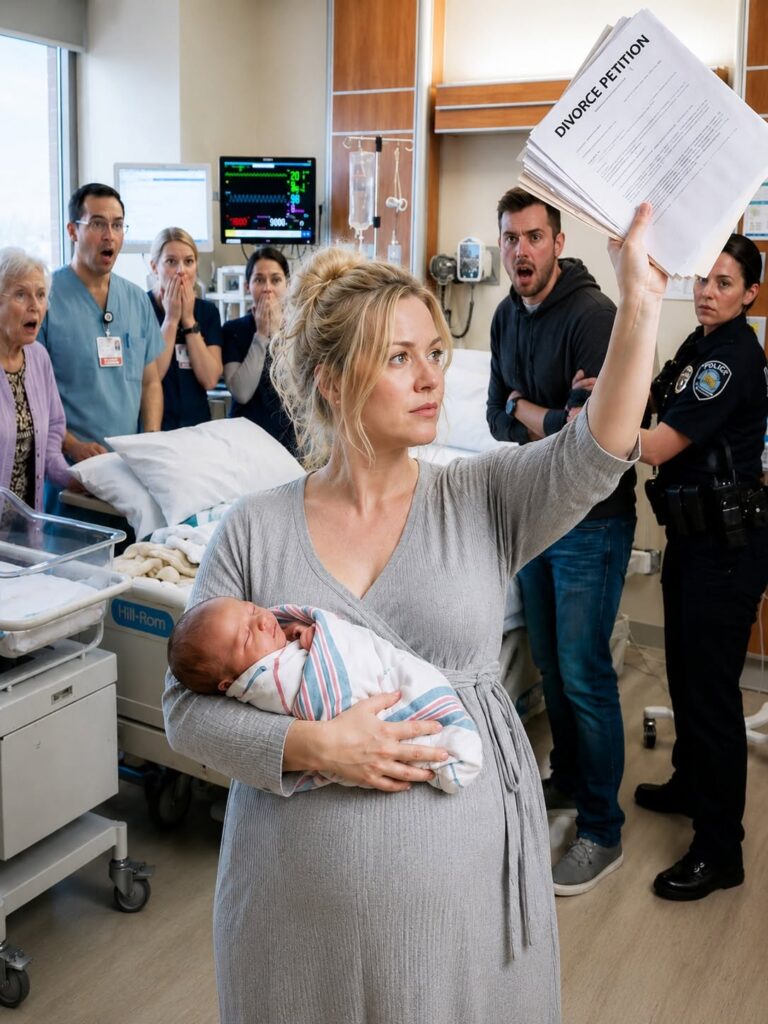
My husband locked me inside our house while I was in labor, then chose his mother’s birthday over our baby. Two days later, he came home smiling with leftover cake — until the bl00d, the broken door, and the court order destroyed everything he thought he still had.
As the first contraction rippled through me, I stood in the kitchen, gripping a glass of water that slipped from my hand and exploded into pieces across the tile.
“Ethan,” I whispered, one hand pressed against my stomach. “Something isn’t right.”
My husband lifted his eyes from his phone with the irritation of someone whose important evening had been disturbed. He already wore a charcoal suit, his hair slicked neatly back, his expensive watch catching the glow beneath the kitchen lights. His mother, Patricia Walker, was celebrating her sixty-fifth birthday that night.
Without warning, his phone began ringing. He switched it to speaker.
“Don’t tell me Madison is pulling one of her stunts again,” his mother sighed over the call. “If you miss my champagne toast, Ethan, I will be humiliated.”
Another contraction crashed over me, even stronger than before. I bent across the counter, gasping for breath.
“Ethan, please. I think the baby is coming.”
He let out an impatient eye roll. “Madison, stop making this so dramatic.”
Those words felt even colder than fear itself.
I was thirty-eight weeks pregnant. My physician had warned both of us that my blood pressure remained dangerously unstable. She had told Ethan directly that if I experienced severe pain or any bleeding, I needed immediate transportation to the hospital.
Now perspiration drenched my dress, my legs trembled beneath me, and every nerve in my body warned that something was terribly wrong.
Ethan grabbed his car keys. “You always pull this,” he snapped. “You turn everything into an emergency the moment my family needs me. You can wait a couple of hours.”
Then he walked out.
One second later, an electronic chime echoed through the house.
Ethan had used the app on his phone to engage the deadbolt from outside.
He had locked me inside so I couldn’t follow him.
That was when I noticed the blood.
A deep crimson pool spreading quickly across the white tiles. Enough to make the room begin spinning.
My hands trembling, I dragged my body toward the front entrance, horrified because the reinforced smart door wouldn’t open. The house completely silent, that massive mahogany door standing between me and my only chance to survive.
I remembered his mother’s mocking voice through the speakerphone. I remembered Ethan glancing at his watch, caring more about a birthday toast than the life of his unborn daughter.
Every contraction now felt like something tearing apart.
Gathering the last strength I had, I reached for my phone and dialed 911, my vision narrowing into darkness.
“My husband locked me in,” I whispered to the dispatcher. “I’m alone. I’m bleeding. Please…”
The call fell silent as my hand gave out.
Two days later, Ethan and his mother returned home smiling, laughing, carrying leftover slices of fondant cake. They expected to find an exhausted, pouting wife prepared to apologize for “ruining” their special evening.
Instead, the moment Ethan opened the front door, he let out a scream of pure horror at the devastating scene waiting inside.
What did Ethan find behind that door — and what had Madison already set in motion before he even stepped inside? Full story in the comments 👇
FULL STORY
What Ethan found was not Madison.
The tile had been cleaned — paramedics, then a neighbor named Carol who had a spare key and had heard the 911 call through the neighborhood emergency alert system. The broken glass swept up. The smart lock disengaged by the fire department after the dispatcher traced the call and flagged the locked-door detail to responding units.
What remained was a broken door frame where firefighters had forced entry before the app override came through. A paramedic’s torn glove on the kitchen floor. A single handprint in dried red on the wall beside the hallway, at the height of a woman who had been crawling.
Ethan stared at it.
Patricia stood behind him with her cake box and her champagne breath and said nothing.
The house was empty.
There was a note on the kitchen counter, placed by Carol, in Carol’s handwriting because Madison had been unconscious by the time they reached her.
Your wife and daughter are at St. Catherine’s. You should know the police have your lock records. Call an attorney.
Patricia read it over his shoulder.
“It’s not as bad as it looks,” she said.
Ethan didn’t answer.
For the first time in their marriage, he had nothing to say.
Clara arrived at 11:47 PM, four pounds nine ounces, delivered by emergency cesarean forty minutes after the ambulance reached St. Catherine’s.
She was small. She was early. She spent her first six hours in the NICU under warming lights while doctors monitored her breathing and Madison recovered from surgery in a room down the hall, blood pressure finally stable, an IV in each arm, Carol asleep in the chair beside her because Carol was sixty-three years old and had decided sometime around midnight that she was not leaving.
I learned all of this later, in pieces, the way you learn things when your body has been through something it wasn’t sure it would survive.
What I knew immediately, the moment I was conscious enough to understand, was that Clara was alive.
And that my phone, retrieved from the kitchen floor by paramedics, had recorded seventeen minutes of audio before the call dropped — including the electronic chime of the smart lock engaging, Ethan’s voice saying you can wait a couple of hours, and the sound of his car leaving the driveway.
The dispatcher had flagged it.
The responding officer had flagged it.
By the time Ethan walked through our front door and found the broken frame and Carol’s note, Detective Ana Reyes had already reviewed the recording twice.
Ethan came to the hospital the following morning.
He stood in my doorway in yesterday’s suit, no tie, his face carrying something I had never seen on it before — not guilt exactly, not yet, but the beginning of understanding that the ground had shifted while he wasn’t paying attention.
“Madison,” he said.
Carol looked up from her coffee cup and did not stand or speak.
I looked at him from the bed.
“Ethan,” I said. “You should know my attorney was here an hour ago.”
Something moved across his face. “You called an attorney before you called me.”
“You locked me in the house,” I said. “While I was bleeding on the kitchen floor. You turned off the deadbolt from a birthday party and got back to the champagne toast.” I kept my voice level. “What exactly were you expecting me to call you about?”
He stepped inside. “I didn’t know it was that serious.”
“My doctor told you directly. She told you in front of me, in her office, six weeks ago. If there is bleeding or severe pain, go immediately. Those were her exact words.” I paused. “You were there.”
“I thought you were—” He stopped.
“Pulling a stunt,” I said. “I know. Your mother said it on speakerphone. The 911 recording has that part too.”
His jaw tightened. “The recording.”
“Seventeen minutes. Including the lock engaging.”
He sat down in the chair across the room without being invited. For a long moment he looked at his hands.
“How is she?” he asked finally.
“She’s in the NICU. She’s stable.” I looked at him. “Her name is Clara.”
“I know her name.”
“You’ve never said it.”
He had no answer for that.
“You should go,” I said. “The detective wants to speak with you this afternoon. I’d suggest you don’t come back here before you’ve spoken to your attorney.”
“Madison—”
“Ethan.” My voice was quiet and entirely final. “Go.”
Detective Reyes met with Ethan that afternoon in a conference room at St. Catherine’s administrative wing — a courtesy to me, keeping it off the main floor, though the courtesy was not extended to him in any other way.
I was not in the room. My attorney, Rachel Cho, was. She told me afterward that Ethan had arrived with his own counsel, a corporate lawyer named Briggs who spent the first ten minutes explaining that the smart lock had been engaged accidentally via a pocket-dial scenario.
Reyes had placed a printed transcript of the 911 recording on the table.
“Mr. Walker,” she said, “your voice is on this recording saying, and I’m quoting directly, ‘you can wait a couple of hours.’ Followed by the sound of a door closing and a vehicle departing.” She slid the transcript toward him. “At what point in that sequence did the accidental pocket-dial occur?”
Briggs intervened. Ethan said nothing.
“We also have the app server logs,” Reyes continued. “The deadbolt was engaged at 7:43 PM from a device registered to Ethan Walker. The same device was used to order an Uber to the Willowbrook Hotel at 7:44 PM.” She looked at him. “One minute after locking the door.”
Briggs asked for a recess.
Reyes said that was fine. “We’ll be filing charges this week regardless of what’s said in this room. I wanted to give Mr. Walker the opportunity to make a statement before that happened.”
Ethan made no statement.
The charges were filed four days after Clara came home from the NICU.
Criminal domestic violence. Reckless endangerment. Unlawful imprisonment.
The unlawful imprisonment charge was the one that surprised Ethan most, according to Rachel, who heard it from Briggs in a hallway exchange that Briggs probably shouldn’t have shared. Ethan had apparently told his attorney he didn’t realize locking someone inside a house from the outside, preventing them from leaving during a medical emergency, could constitute unlawful imprisonment.
“It can,” Rachel told me over the phone, in the dry tone she used when something was both legally obvious and profoundly human. “It very much can.”
Patricia called me twice that week. I let both calls go to voicemail. The first message was about how devastated she was, how none of this was what anyone intended, how family should handle things privately. The second was shorter and less careful: she hoped I understood that pursuing this was going to destroy Ethan’s career and that some things, once broken, couldn’t be fixed.
I saved both messages and forwarded them to Rachel.
“Witness intimidation territory,” Rachel said. “Or close enough. She should stop calling.”
Patricia stopped calling.
The divorce filing landed two weeks after the criminal charges.
Ethan’s attorney tried several approaches in the early weeks. That the lock had been accidental. That Madison had a history of anxiety that caused her to catastrophize medical situations — a claim that dissolved immediately when Dr. Vance, my OB, submitted a statement describing in precise clinical language the documented blood pressure instability, the specific warnings she had given Ethan in her office, and her professional opinion that the delay in emergency care had materially increased risk to both mother and child.
Then Briggs tried a different direction: that Madison had known about the smart lock feature and could have called 911 earlier, reducing the severity of the emergency. This argument lasted until Rachel submitted the 911 call log showing I had called within four minutes of Ethan leaving, and the paramedic’s report noting that the locked door had delayed entry by approximately eleven minutes.
Eleven minutes, the report noted, is clinically significant in a hemorrhagic obstetric emergency.
Briggs stopped making arguments about the lock after that.
Ethan requested to see Clara.
Rachel brought the request to me on a Tuesday morning while I was feeding her in the kitchen, the same kitchen where the tile had been scrubbed and the broken glass swept and the handprint washed from the wall beside the hallway.
I looked at Clara’s face — round, serious, entirely unaware of any of it — and thought about what I wanted her to know about how decisions get made.
“Supervised visitation,” I said. “Neutral location. Not this house.”
Rachel nodded. “That’s what I expected you to say.”
“And not until the criminal case resolves.”
“Also expected.”
“I’m not keeping her from him forever,” I said. “I’m keeping her from the version of him that locked her mother in a house and went to a birthday party.”
“Those may be the same version for a while.”
“Then it’ll be a while,” I said.
The criminal case took ten months.
Ethan pleaded guilty to reckless endangerment and unlawful imprisonment. The domestic violence charge was reduced as part of the agreement. He received eighteen months probation, mandatory counseling, a fine that his attorney had clearly negotiated down from something larger, and a permanent record that followed him out of every room his name had previously opened easily.
His firm placed him on administrative leave the week the charges were filed. By the time the plea was entered, he had been quietly moved to a consulting role that everyone understood was a managed exit.
Patricia did not attend the court hearing. Ethan stood at the defendant’s table in a suit that fit exactly as well as the one he’d worn to his mother’s birthday party, and listened to a judge explain the terms of his probation in the same room where, ten months earlier, he’d assumed there would be no consequences at all.
I was not there either.
I was at Carol’s house, two blocks from mine, eating lunch while Clara slept in a borrowed bassinet in the next room. Carol had made tomato soup, the same thing she always made when she didn’t know what else to do, and we sat at her small kitchen table and talked about nothing important for an hour, which was exactly what I needed.
My phone buzzed with Rachel’s text at 12:34 PM.
Guilty plea entered. Probation as discussed. It’s done.
I set the phone facedown on Carol’s table.
“Done,” I said.
Carol refilled my soup without asking. “Good,” she said. “Now eat.”
The divorce finalized six months after the criminal case closed.
I kept the house. Ethan kept his car, his remaining accounts, and the particular silence of a man who had lost the argument he’d been certain he would win.
He sees Clara on alternating Saturdays now, supervised for the first six months, transitioning to unsupervised as the counseling progressed and the probation officer’s reports remained clean. He is, by every account I receive through Rachel, showing up on time and sober and present in the way he had not been when it mattered most.
I don’t know if people change. I know they can try.
What I know with certainty is that Clara will grow up in a house where the door is never locked against her, where her emergencies are taken seriously, and where the adults around her understand that love is not the thing you say at a birthday party — it is the thing you do at 7:43 on a Tuesday night when someone you are supposed to protect is bleeding on the kitchen floor.
Carol came for dinner on Clara’s first birthday.
She brought tomato soup, which made me laugh, and a stuffed rabbit with enormous ears that Clara immediately tried to eat.
We sat at the kitchen table — the same table, the same tile, entirely ours now — and watched Clara investigate the rabbit with the focused intensity of someone encountering something genuinely new.
“She looks like you,” Carol said.
“Everyone keeps saying that.”
“It’s true.” Carol watched her for a moment. “She has your stubbornness too. I can already tell.”
“That’s not stubbornness,” I said. “That’s knowing what she wants.”
Carol smiled. “Yes,” she said. “Exactly that.”
Clara looked up at both of us then, rabbit in hand, with the expression of a person who has just figured something out and is deciding whether to share it.
I picked her up and held her against my chest — her small weight warm and certain, her heartbeat steady against mine — and thought about the kitchen floor and the broken door and the handprint on the wall and the 911 call and the eleven minutes and all the ways that night could have ended differently.
It had not ended differently.
We were here.
The door was unlocked.
And the rest of it — the probation, the divorce, the career that had quietly collapsed under the weight of what Ethan had chosen — all of that was finished now, filed away, done.
What remained was this kitchen, this table, this child in my arms who had arrived fighting and had not stopped since.
I pressed my face into her hair.
“I’ve got you,” I said.
She grabbed my ear in response, which I decided to interpret as I know. 💙
Some people only understand what protecting someone actually means after they’ve proven, beyond any doubt, that they won’t do it. Have you ever had to rebuild your life from the moment someone showed you exactly who they were? Share below 👇