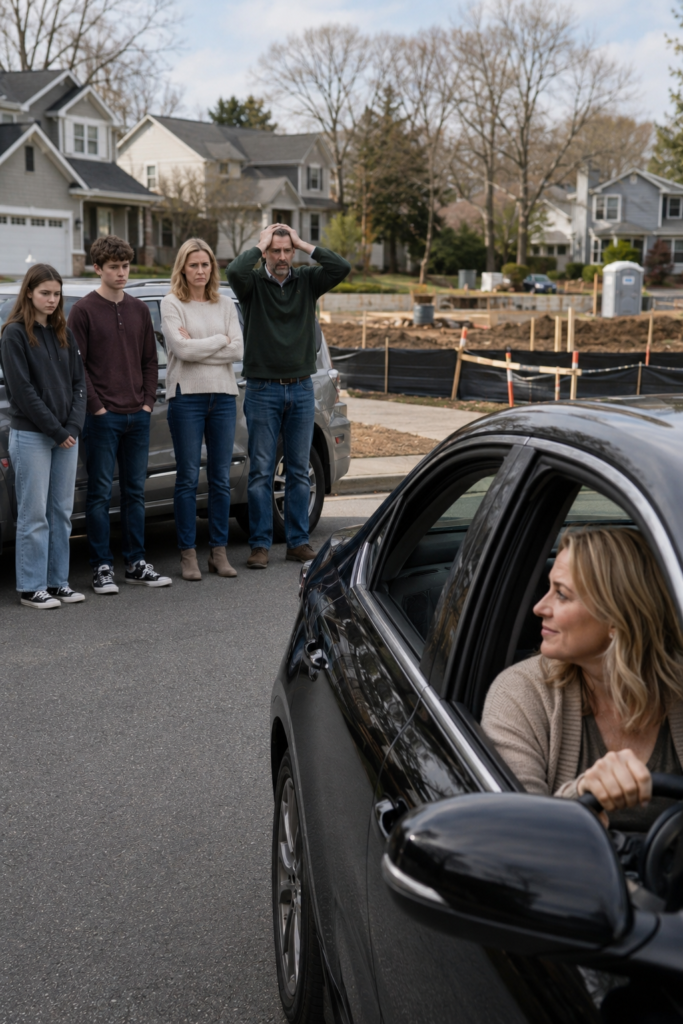
My ex-husband thought flying his new wife, our teenagers, and his whole family to Europe for his expensive second wedding would break me.
Before boarding, he sent a text saying he was “finished with old things” and wanted me out before they came back. I let him think I had surrendered. What he never knew was that while he celebrated along the Amalfi Coast, my attorney was quietly setting up the surprise waiting back home. The morning his plane landed, I watched from farther down the street as he turned into the driveway — and went completely white when he saw the house was gone.
The message came through at exactly 2:13 in the morning.
I remember the time because I was not asleep.
The ceiling fan moved slowly above me as the old house settled into the silence of the dark, its familiar creaks sounding almost like quiet warnings.
When my phone glowed on the nightstand, I foolishly hoped it was Logan checking in before his flight.
Maybe he had reconsidered.
Maybe something had gone wrong.
Maybe, after almost twenty years together, he had remembered that I still existed.
Instead, I saw six words that destroyed every last illusion I had.
Be gone before we come back.
I hate old things.
I deserve a fresh life.
I stared at the screen.
Then another text arrived.
Don’t cause a scene. The kids are with us.
I flipped the phone facedown and lay completely still in the darkness.
The fan kept turning.
The house kept making its soft, tired sounds.
Somewhere above the Atlantic Ocean, my husband was probably asleep in peace beside the woman he had chosen to put in my place.
Logan Sterling had always been shockingly efficient with cruelty. No unnecessary words. No apologies. No pause. Every conversation felt like one of his corporate meetings. He made the decisions first. Then told everyone afterward.
For years, I confused that certainty with confidence.
Eventually, I understood the difference between true self-assurance and a man who simply believed he could never be wrong.
Three weeks earlier, he had ended our marriage while we sat at the kitchen island with morning coffee. He did not ease into it. He placed his hands together on the counter like a chief executive presenting quarterly earnings.
“I’m starting over,” he said.
No emotion. No remorse. Only a statement he had clearly rehearsed.
Her name was Sienna. Twenty-six years old. She worked in the marketing department at his company. According to Logan, she made him “feel alive again.”
While he kept describing his thrilling new future, I found myself staring at my coffee mug. Our daughter had made it for me in sixth grade. The painted letters were crooked. The handle had been chipped for years. The small flower she had tried to draw looked more like a bright yellow burst.
I could not look away from it.
All the while, Logan calmly explained that he had already “taken care of everything.”
As if nineteen years of marriage could be sorted into a task list and finished before lunch.
His greatest achievement was the wedding. A lavish destination ceremony on Italy’s Amalfi Coast. Luxury villas facing the water. Fresh orchids. Black-tie dinners. Private yacht outings. Endless champagne. Every detail designed to impress.
He invited his parents. His siblings. Business associates. Friends who had spent holidays in our home for years. People who had held me after my father’s funeral and promised we would always be family.
He even invited our children.
Marcus, seventeen, already carrying his father’s confidence and stubborn pride. Lily, fifteen, still trying to make sense of the divorce and quietly blaming me for everything.
Only one person was missing from the guest list.
Me.
Not through a fight. Not through a confrontation. Logan simply sent the shared family travel schedule. Flight details. Hotel bookings. Dress code. Everything arranged — as though my absence needed no explanation.
He truly believed I would vanish quietly while he raised a glass to his new beginning beneath the Mediterranean sun.
What Logan never understood was that the house he so casually ordered me to leave had never really belonged to him.
The land had been my father’s long before I ever met Logan.
The legal papers had been carefully arranged years before.
And while he spent his honeymoon uploading smiling photos from Italy, my attorney was not grieving the end of my marriage.
She was preparing the start of his greatest mistake.
What did Logan’s plane land to find — and what had Claire quietly set in motion while he was toasting his new beginning? Full story in the comments 👇
FULL STORY
I called Patricia Dunn at 2:47 that same morning.
She answered on the third ring, which told me she had been expecting the call.
Patricia had been my attorney for eleven years — since the contract dispute after my father died and left me the property that Logan had spent nineteen years treating as his own. She had a voice like a woman who had never once doubted her next sentence.
“He sent the text,” I said.
“I assumed,” she said. “Timing?”
“They board at six AM.”
“Then we have ten days.” A pause, the sound of paper. “Claire, I need you to say it out loud. Because once we start, we don’t stop.”
I looked at the ceiling fan.
At the dark room.
At nineteen years of accumulated evidence that I had been confusing endurance for dignity.
“Start,” I said.
The property had been my father’s since 1987.
He bought the land before the neighborhood was anything, when it was still scrub grass and oak trees and a road that flooded in heavy rain. He built the house himself over three years, weekends and evenings, with his brother and two friends and a stubbornness about doing things correctly that I had apparently inherited.
When he died, the land transferred to me through a trust he had established specifically to prevent it from becoming marital property in the event of a divorce. My father had liked Logan well enough — had respected his ambition, tolerated his certainty — but he had not trusted certainty without character, and he had drawn the legal lines accordingly.
Logan had signed the prenuptial agreement without reading it.
He had signed it the way he signed everything that didn’t directly concern his quarterly goals: quickly, as a formality, with the impatience of a man who expected the details to work themselves out because they always had.
The prenuptial agreement specified that the property remained mine in all circumstances.
It also specified that any improvements to the property funded through marital assets were subject to offset, not claim.
Logan had funded a kitchen renovation six years ago. He had mentioned it at dinner parties as evidence of his generosity. Patricia had tracked every dollar of it.
“The offset is approximately forty-two thousand,” she told me on day three of the ten days. “Which, against the property value, is meaningless. He’ll push for it. We’ll offer it. He won’t get the house.”
“He thinks it’s his house,” I said.
“I know,” Patricia said. “People often think things that aren’t true. That’s what makes the paperwork important.”
The first thing I did after Logan’s plane took off was sleep.
Twelve hours, in the house that was mine, in the bed I had made every morning for nineteen years, in the silence that was suddenly the most peaceful thing I had experienced in months.
The second thing I did was call my sister, Renata, who arrived that afternoon from two hours away with a bottle of wine and the immediate, clarifying presence of someone who had disliked Logan from year three of the marriage and had been carefully not saying so for sixteen years.
“I’m not going to say I told you so,” she said.
“You already said it with your face,” I said.
“My face is honest.” She poured two glasses. “Tell me what Patricia is doing.”
I told her.
Renata listened without interrupting, which was unusual for her. When I finished, she was quiet for a moment, and then she said: “He really doesn’t know.”
“He’s on a yacht somewhere off the Amalfi Coast,” I said. “He’s posted four photos in three days. All of them with champagne.”
“Show me.”
I showed her.
Logan in a white linen shirt, grinning. Sienna beside him in something that cost more than my car payment. The family table at a cliffside restaurant, everyone laughing, my children present and smiling in the particular performance of teenagers who have decided public happiness is a better strategy than the alternative.
“Lily looks like she’s trying,” Renata said.
“She is,” I said. “She’s good at trying.”
“Marcus?”
“Marcus looks exactly like Logan at seventeen.” I set the phone down. “I’m not sure whether to be worried about that or not.”
“He has your stubbornness underneath it,” Renata said. “You just have to wait for it to show up.”
I wasn’t sure she was right. But I wanted her to be.
On day six, Patricia filed the formal eviction notice.
Not against Logan — he was a spouse, not a tenant, and the divorce proceedings handled his claim to the property. The eviction was against Sienna.
Logan had, in the week before the wedding, moved several of Sienna’s possessions into the house. Clothing, personal items, what appeared from the photographs to be a very expensive espresso machine. He had done this without informing me, presumably operating on the assumption that I would be gone before he returned and therefore the question of whose house it was would resolve itself through absence rather than paperwork.
Sienna had no lease. No legal claim. No documentation of any kind connecting her to the property.
The eviction notice was filed, served to the address on record, and posted on the front door of the house in accordance with local statute.
Patricia sent me a photograph of it.
I stared at it for a long time.
The house behind it looked the same as always. The oak tree my father had planted in 1989 in the front yard. The porch he had built with his brother, the railing slightly uneven in one spot where they’d run short of lumber and improvised. The front door I had painted blue four years ago over Logan’s objection that it was “unprofessional for the neighborhood.”
The door was still blue.
Marcus called on day seven.
I had not spoken to either of my children since the flight. Logan had managed the communication, which meant there had been no communication — just occasional group photos forwarded through the family thread with captions I suspected he wrote himself.
My son’s voice on the phone sounded older than seventeen and younger than he was trying to sound.
“Mom.”
“Hi, sweetheart.”
“Are you okay?”
“I’m fine,” I said. “Are you having a good time?”
A pause. “It’s beautiful here. The food is—” He stopped. “Dad says you’re moving out.”
“Your father and I are working through some things legally,” I said. “But I want you to know that however it looks from there, I’m fine.”
“He says you’re being difficult.”
“Marcus.” I kept my voice even. “Your father says a lot of things. So do I. When you’re home, you can ask me anything you want and I’ll tell you the truth. But I’m not going to have that conversation while you’re on a boat in Italy.”
A long pause.
“The prenup,” he said. Quietly. Like he’d heard it mentioned and looked it up.
“Yes,” I said.
“He doesn’t know, does he.”
It wasn’t quite a question.
“No,” I said. “He doesn’t.”
Another pause.
“Okay,” Marcus said. And then: “I love you, Mom.”
“I love you too,” I said. “Eat the pasta. It’ll be better than anything you’ve had before.”
He almost laughed. Almost.
Logan’s plane landed on a Tuesday morning.
I knew the arrival time because it was the same flight information he had sent in the original family travel schedule, the document in which my absence had needed no explanation.
I parked two blocks down the street, far enough to be invisible, close enough to see the driveway.
Renata sat beside me in the passenger seat with coffee she had brought from a drive-through twenty minutes earlier. We did not speak much. The radio was off. The morning was cool and bright, the kind of October day that looks like a photograph of itself.
At 9:47 AM, Logan’s rental car turned into the street.
I watched him slow as he approached the driveway.
He stopped the car.
He sat there for what I estimated was thirty seconds, though it felt longer.
Then he got out.
He stood in the driveway looking at the front door.
At the eviction notice, still posted where Patricia had put it.
At the locksmith’s notice beside it, confirming the locks had been changed and key collection required legal authorization.
At the blue door, which was still blue.
His face from two blocks away was not readable in detail. But the posture was. The stillness of a man who had landed expecting to walk into a house he owned and found, instead, a legal document explaining that he did not.
Sienna got out of the passenger side.
She read the notice.
She turned to Logan.
I did not need to hear the conversation.
Logan called Patricia within the hour.
Patricia took the call, listened to what she later described as “a man who had confused volume with argument,” and responded by reading him the relevant clauses of the prenuptial agreement he had signed nineteen years ago in under three minutes, then informing him that any further questions should be directed to his attorney.
He called me four minutes later.
I let it go to voicemail.
His message was ninety seconds long and covered, in order: disbelief, accusation, a suggestion that I had manipulated the legal documents, and a closing statement about how I had “always been vindictive.”
I saved the voicemail and sent it to Patricia.
“For the record,” she said.
“For the record,” I agreed.
The legal proceedings took seven months.
Logan hired a corporate attorney named Brice who spent the first two months attempting to challenge the validity of the prenuptial agreement on the grounds that Logan had not had independent legal representation at signing.
Patricia produced the waiver Logan had signed confirming he had been offered independent counsel and had declined.
Brice pivoted to the kitchen renovation offset.
Patricia offered forty-two thousand dollars in settlement of that claim. Logan held out for sixty. Patricia held at forty-two. Logan eventually accepted forty-two, which Brice framed as a victory in a way that fooled no one.
The house remained mine.
The divorce was finalized on a Thursday afternoon in April. Patricia called me as I was standing in the kitchen making tea and told me in the same matter-of-fact voice she used for everything that it was done.
“Done,” I repeated.
“Done,” she said. “The decree is being filed today. I’ll send you a copy.”
I looked at the kitchen. The mug Lily had made me in sixth grade, chipped handle and crooked letters and the bright yellow flower that looked more like a burst than a bloom.
“Thank you, Patricia,” I said.
“It was a clean case,” she said. “He made it clean.”
“He always was efficient,” I said.
She almost laughed. “Get some rest,” she said. “You’ve earned it.”
Marcus came home first.
He arrived with a duffel bag and three days of silence he clearly needed to work through before he could talk to anyone, which I understood and did not push. He ate dinner at the kitchen table. He watched television in the living room. He asked once, on the second evening, whether I was going to sell the house.
“No,” I said.
“Good,” he said. And went back to his show.
On the third day he sat across from me at the kitchen island — the same island where Logan had ended the marriage with his hands folded like a corporate meeting — and said: “Dad told me you ambushed him.”
“I used the legal protections available to me,” I said. “Your grandfather set them up a long time ago because he understood people.”
Marcus thought about this.
“He didn’t read the prenup,” he said.
“No.”
“That seems like his problem.”
“Patricia agrees,” I said.
Marcus almost smiled. The expression moved across his face and then went back to wherever he was keeping things, but I saw it.
My father’s stubbornness, underneath.
Right where Renata said it would be.
Lily took longer.
She arrived two weeks after Marcus, quieter, with the particular careful politeness of a teenager who is managing her feelings by managing her behavior. She helped clear the table after dinner. She asked before using my car. She did not mention Logan or Sienna or Italy for the first four days.
On the fifth day, she came into the kitchen while I was washing dishes and stood beside me and said, without looking up: “I thought you were just letting him win.”
“I know,” I said.
“You didn’t say anything. He kept saying things and you just—” She stopped. “I thought you’d given up.”
“I was waiting,” I said.
“For what?”
“For the right moment. And for your grandfather’s paperwork to do what he built it to do.”
She was quiet for a moment.
“I blamed you,” she said. “For a while.”
“I know that too.”
“I’m sorry.”
I turned off the water and looked at her. At fifteen, she had my father’s eyes and Logan’s chin and something entirely her own in the way she held herself when she was trying to be honest.
“You were trying to understand something that didn’t make sense,” I said. “That’s not something you need to apologize for.”
She leaned her head against my shoulder.
I put my arm around her.
We stood there in the kitchen for a moment, in the house that was mine, in the quiet that had stopped feeling like surrender and started feeling like something else.
Something closer to beginning.
Logan married Sienna in a civil ceremony six months after the Amalfi Coast trip. The destination wedding had been the public performance. The legal marriage was smaller, faster, and photographed only twice.
He and Sienna rented an apartment in a part of the city he had previously described as “not where people like us live.”
He sent child support on time, which Patricia had structured in a way that made defaulting legally inadvisable. He attended the school events he was meant to attend. He was, in the careful, managed way of a man rebuilding a public image, not entirely absent.
I did not watch for updates. Renata occasionally mentioned things she had seen, which I accepted with the detachment of someone who has learned that other people’s stories become less consuming once you are fully inside your own.
The following summer, I repainted the front door.
Not because the blue was wrong. Because Lily asked if she could help, and I said yes, and we spent a Saturday morning on the porch with brushes and a new can of the same color, touching up the places where the winter had worn the paint thin.
Marcus sat on the porch steps with a book and occasional opinions about our technique.
The oak tree my father planted in 1989 made shade across the yard.
The railing my grandfather and his brother had improvised was still slightly uneven in the same spot.
When we finished, Lily stood back and looked at the door.
“It looks the same,” she said.
“That was the point,” I said.
She considered this.
“Dad said it was unprofessional,” she said.
“Your dad,” I said, “didn’t own the door.”
Marcus looked up from his book.
For a moment, all three of us were quiet in the shade of the oak tree, in front of the blue door, in the house that had always been mine.
Then Marcus said: “It’s a good door.”
“It’s a great door,” Lily said.
I looked at both of them.
My father’s stubbornness. My mother’s eyes. Something entirely their own in the way they said the things they meant.
“Yes,” I said. “It is.” 💙
Some people mistake your silence for surrender. They forget that the quietest preparation is often the most thorough. Have you ever let someone believe they had won — and then watched the paperwork prove otherwise? Share below 👇