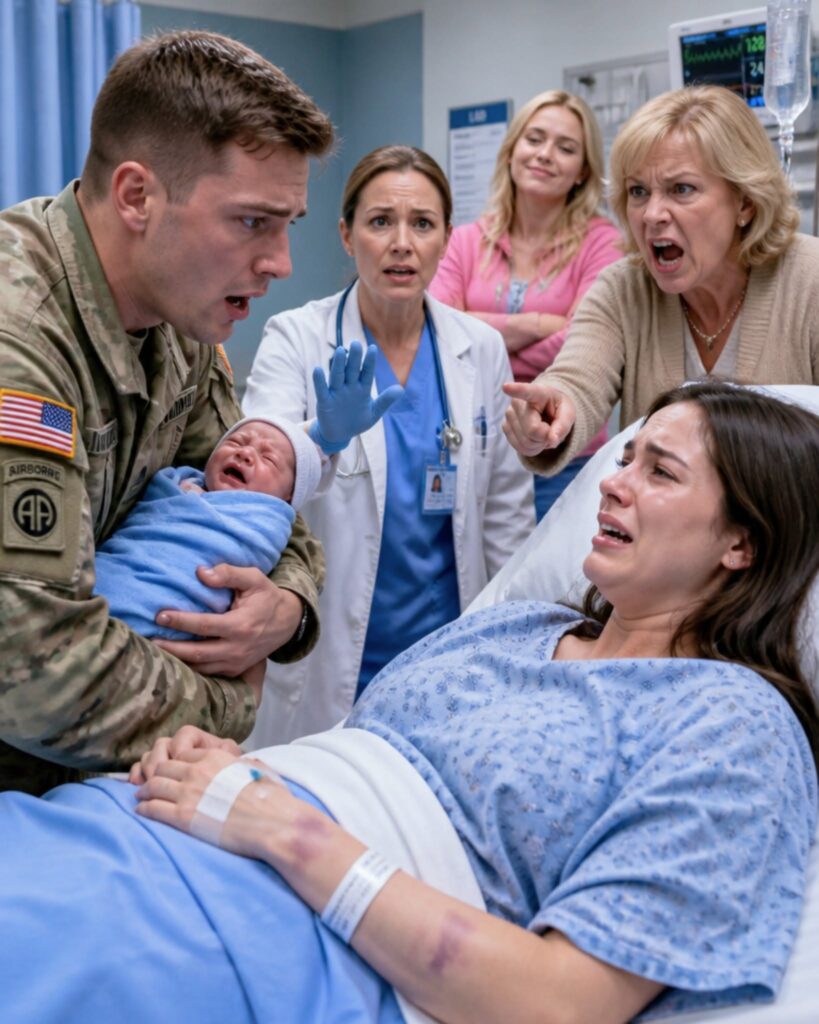
After eight months away on military duty, I came home to find my newborn son burning with fever and my wife curled up beside his crib, her arms covered in bruises.
My mother smirked, “She needed to be taught a lesson,” while my sister scoffed, “The baby is her responsibility.” I didn’t raise my voice. I simply waited until military police, child protective services, and my attorney walked through the door behind me. By sunrise, they had been arrested, cut out of the family estate, and forced out of the home they wrongly believed was theirs.
The first thing I heard after unlocking the front door was my newborn son crying so weakly it sounded as though he had no strength left.
The second was my mother’s voice.
“Leave him alone. He’ll learn eventually.”
My duffel bag slipped from my shoulder and hit the hallway floor.
Eight months overseas had sharpened my instincts.
I had learned to recognize danger long before anyone else noticed it.
The silence between Leo’s cries wasn’t normal.
The sour smell of spoiled formula wasn’t normal.
The house felt unbearably hot, yet my wife, Sophia, was shivering on the nursery floor beside the crib.
One side of her face was badly swollen.
Dark finger-shaped bruises wrapped around both of her arms.
“Sophia.”
She lifted her head.
Fear flashed across her face before relief finally appeared.
“Lucas…”
Before she could say another word, my mother, Eleanor, stepped into the doorway wearing Sophia’s silk robe as if it belonged to her.
My sister, Audrey, followed behind her with a glass of wine in her hand.
Eleanor folded her arms.
“She needed to be taught a lesson.”
Audrey shrugged.
“And we’re not babysitters. The baby’s her responsibility.”
Ignoring both of them, I reached into the crib and pressed my hand against Leo’s forehead.
His skin was burning.
“How long has he had this fever?”
Sophia opened her mouth.
“He—”
“Since yesterday,” Eleanor interrupted. “She’s making it sound worse than it is.”
Sophia shook her head weakly.
“It reached one hundred four degrees. They took my phone. They wouldn’t let me leave.”
Audrey laughed.
“You’ve always had a thing for helpless women.”
I looked at them without raising my voice.
Anger clouds judgment.
Silence makes people reveal everything.
“Why is Sophia on the floor?”
Eleanor smiled with complete confidence.
“Because this is my house, and she needed to remember her place.”
That was the moment she destroyed her own defense.
The house had never belonged to her.
Three years earlier, after my grandfather passed away, I purchased the property through a military family trust. My mother had been granted temporary permission to stay. Nothing more. No ownership. No lease. No legal authority over anyone living inside those walls.
While I was deployed, Sophia’s messages gradually became shorter. Then they stopped altogether. Each time I asked why, Eleanor insisted Sophia was exhausted and wanted privacy.
I acted as though I believed every word.
What she never suspected was that my commanding officer had already arranged my early return, while a welfare investigation quietly began weeks before I arrived home.
Carefully, I lifted Leo from the crib and wrapped him in a soft blanket.
Audrey stepped directly into my path.
“And where do you think you’re taking him?”
“To get my son medical treatment.”
Eleanor sneered. “You’ll settle down once you’ve heard our side of the story.”
I glanced toward the front windows as bright headlights swept across the living room.
“I’ve already heard everything I need.”
Outside, several vehicle doors opened one after another.
For the first time, Eleanor’s confident smile disappeared.
Audrey looked toward the driveway, suddenly uneasy.
Neither of them knew that for the past six weeks I had been quietly gathering evidence — bank records, deleted text messages, recordings from the nursery camera they believed had stopped working, and the desperate emails Sophia had managed to send to her father before they confiscated her phone.
They still believed they were dealing with a soldier trained only to follow orders.
They had forgotten that soldiers are also trained to prepare long before the battle begins.
What walks through that door behind Lucas — and what six weeks of evidence is about to dismantle everything Eleanor believed she controlled? Full story in the comments 👇
FULL STORY
Three vehicles.
Military police. A CPS field investigator named Karen Osei. And my attorney, Daniel Merritt, who had driven two hours from Raleigh and arrived in a suit at eleven-thirty at night without complaint because I had asked him to.
Eleanor saw the military police first.
The confidence left her face in a single motion, like a light switching off.
“Lucas,” she said. “Whatever you think—”
“Don’t.” I kept my voice level. “Not in front of Sophia.”
Karen Osei moved past me into the nursery without waiting for an introduction. She crouched beside Sophia, spoke quietly, produced a business card, and began documenting the bruising on Sophia’s arms with a camera before Eleanor could form her next sentence.
The senior MP, Sergeant Vance, stood in the hallway with a clipboard and looked at Eleanor the way men who have seen actual danger look at people who have confused cruelty with power.
“Ma’am,” he said. “I need you and the other adult to stay in the living room while we complete our assessment.”
“This is my house,” Eleanor said.
“It isn’t,” Daniel said, from behind Sergeant Vance, holding a folder. “The deed is held in trust by Lucas Hale. I have the documentation.”
Audrey set her wine glass down on the hallway table.
For the first time since I’d arrived, she said nothing.
Leo’s fever was 103.4 by the time the paramedics cleared the door.
Still high. Lower than the 104 Sophia had reported before they took her phone. The paramedic, a young woman named Torres, gave him a rapid assessment in the nursery while I stood beside the crib and Sophia sat against the wall with Karen Osei’s hand on her arm.
“He’s dehydrated,” Torres said. “How long since his last feeding?”
Sophia looked at the floor. “They said I was holding him too much. That I was spoiling him.” Her voice was flat in the way of someone who has repeated a sentence so many times it has lost its meaning. “Eleanor said crying was healthy.”
Torres looked at me briefly, then back at Leo.
“We need to take him in,” she said. “Precautionary. He’ll be fine, but I want him on fluids tonight.”
“Yes,” I said.
Sophia tried to stand. Her legs didn’t cooperate immediately. I reached for her arm and she flinched before she caught herself — that automatic recoil, the reflex of someone who had learned that a hand reaching toward her meant something different.
That flinch cost me more than anything else I saw that night.
“I’ve got you,” I said. Quietly. “I’m not going anywhere.”
She let me help her up.
In the living room, Daniel had laid the documentation on the coffee table.
Trust deed. Utility accounts in my name. The temporary residency agreement Eleanor had signed eighteen months ago — two lines, her signature, the date — that granted her permission to occupy the property during my deployment on the condition that she maintained the household and the welfare of its occupants.
Sergeant Vance read it twice.
“Mrs. Hale,” he said to Eleanor, “this agreement contains a conduct clause. Clause four. Any behavior constituting harm or neglect toward household members terminates residency rights immediately.”
Eleanor looked at the clause.
“She misinterpreted—”
“The nursery camera,” Daniel said, “recorded fourteen incidents over the past six weeks. I have the footage. Lucas has had it since he requested remote access to the system three weeks ago.”
Audrey turned toward Eleanor sharply.
Eleanor’s jaw set.
“The camera wasn’t working,” she said.
“It was working,” I said. “I replaced the battery remotely. The system sends me an alert when motion is detected after ten PM.” I looked at her. “I’ve watched the footage, Mom. All of it.”
The room was very quiet.
“She provoked—” Eleanor started.
“Don’t,” Sergeant Vance said. Flat. Final.
They arrested Eleanor at 12:47 AM.
Domestic battery. Child endangerment — the fever and the withheld phone constituting grounds the CPS investigator confirmed on site. Unlawful confinement, for confiscating Sophia’s phone and blocking her from leaving.
Audrey was not arrested that night. Her involvement was harder to document — she had been present, she had laughed, she had done nothing to help, but doing nothing is not a chargeable offense. Daniel told me that plainly in the hallway while the MPs processed Eleanor.
“She walked away clean tonight,” he said. “The civil case is different.”
“What civil case?” I asked.
“The one you’re going to file for psychological harm and material damages to your wife.” He said it the way he said everything — matter-of-fact, already two steps ahead. “Audrey participated. She just participated in ways the criminal statute doesn’t cover. But civil court has a lower threshold.”
I thought about Sophia flinching at my hand.
“File it,” I said.
Leo came home from the hospital the following afternoon.
Forty hours under observation, IV fluids, temperature stabilized by morning. The pediatrician, a man named Dr. Arora who had the calm manner of someone who had seen worse and still cared about this, told us Leo would be fine and that early intervention had made the difference.
“A few more hours,” he said, “and we’d be having a harder conversation.”
Sophia held Leo in the discharge room and did not say anything for a long time. I sat beside her and did not fill the silence, because some silences are not meant to be filled.
Finally she said: “I thought you believed her.”
“What?”
“When she said you were fine. That you were adjusting. That I was being dramatic.” She looked at Leo. “She read me your responses. Every time I found a way to get a message to you, she intercepted the reply and read it to me. She said you were disappointed in me for struggling.”
“I never said that.”
“I know that now.” Her voice was careful. “Then, I didn’t know.”
I thought about eight months of messages I had sent to what I believed was Sophia’s phone, received and filtered and reframed by Eleanor into something designed to isolate.
“She had your phone,” I said.
“From month two.” Sophia shifted Leo gently. “She said I was disturbing your concentration. That soldiers needed to focus. That I was being selfish.”
Eight months. Eight months of Eleanor feeding me reassurances while constructing a completely different reality for Sophia.
“When did you get the message out to your father?” I asked.
“Once. Three weeks ago. She left my phone charging in the kitchen and forgot to take it with her. I had forty seconds.” She looked at me. “I sent him one email. Just: call Lucas’s CO, something is wrong, please hurry.”
Her father had called my commanding officer within the hour. My CO had called me. The early return had been approved within seventy-two hours.
Forty seconds and one email.
That was the margin.
Eleanor’s arraignment was covered by the local paper, which I had not anticipated and could not prevent. The headline was restrained — Woman Faces Domestic Battery Charges Following Military Spouse Welfare Investigation — but the photo, taken outside the courthouse, showed Eleanor in yesterday’s clothes, her expression arranged into something between dignity and disbelief, and it ran on the regional news website for several days.
Her attorney entered a not-guilty plea.
Daniel was not surprised. “They always do,” he said. “Until the camera footage.”
The camera footage was not the kind of thing anyone argues against successfully.
Fourteen incidents. Eleanor’s voice on audio throughout. Twice, Audrey in frame, watching.
The plea changed to guilty three weeks before the scheduled trial date.
Eleanor received eighteen months, suspended pending full restitution and a no-contact order covering Sophia, Leo, and the property. The suspension was contingent on compliance. Her attorney had negotiated well enough to keep her out of a cell, but the record was permanent and the no-contact order was ironclad.
Audrey settled the civil case six months later. The amount was enough to cover Sophia’s therapy through the following year and put a meaningful sum in Leo’s education account. Audrey paid without appearing in court, which Daniel described as the decision of someone who had watched her mother’s trajectory and made a calculation.
I did not feel satisfaction when the settlement came through. I felt something more like the absence of a weight I had been carrying without realizing how heavy it was.
We sold the property in the spring.
Not because we had to. Because Sophia stood in the hallway one evening while Leo slept and said, quietly, that she didn’t think she would ever feel comfortable in that house again.
“Okay,” I said.
“I know it’s your grandfather’s—”
“Okay,” I said again.
She looked at me.
“Just like that?”
“It’s a house,” I said. “You’re not.”
She was quiet for a moment.
“You’re going to make me cry,” she said.
“You can cry,” I said. “I’ll be here.”
She did, briefly, and then she laughed at herself for crying, which was the first time I’d heard her laugh in eight months and the sound of it was worth more than any property value.
We bought a smaller house in a different part of the state. No history in the walls. A yard Leo could eventually destroy at will. A kitchen window that caught the morning light in a way neither of us had planned for but both of us noticed immediately.
Sophia’s recovery was not linear. That is the honest way to say it. There were weeks where the flinching came back, where the sound of raised voices made her go still in a particular way. There were conversations with her therapist that she would describe to me afterward in fragments, working through what eight months of isolation had done to the way she understood herself.
She was patient with the process. I was patient with her.
Slowly, then more steadily, she became more recognizably herself. Her laugh came back first. Then her opinions about how to arrange the furniture. Then her willingness to disagree with me about small things, which was, her therapist had apparently told her, one of the markers to watch for.
“She said disagreeing with your spouse about where to put the couch is a sign of healthy recovery,” Sophia told me one evening.
“The couch is fine where it is,” I said.
“It’s too far from the window.”
“It’s exactly where you wanted it last week.”
“I’ve reconsidered.”
I moved the couch.
She was right about the window.
Leo turned one in our new house, surrounded by people who had chosen to be there — Sophia’s parents, two friends from my unit who had driven three hours, Karen Osei who had become, in the quiet way these things sometimes happen, someone Sophia genuinely trusted.
He had no idea it was his birthday. He had strong opinions about the frosting and no opinions about anything else, which seemed correct for someone who had been alive for exactly one year.
I watched Sophia hold him at the kitchen table, his face covered in cake, her face clean and present and entirely her own, and thought about the nursery floor and the forty seconds and the single email that had reached her father in time.
I thought about how close the margin had been.
And then I stopped thinking about it, because Leo reached for me with both frosting-covered hands, and the margin was the past, and this — this kitchen, this table, this ridiculous amount of cake — was the present.
I picked him up.
He immediately transferred the frosting to my shirt, which seemed intentional.
Sophia laughed.
The sound of it filled the kitchen the way light fills a room when someone finally opens the curtains — not announcing itself, not performing, just there.
Warm.
Entirely real.
Entirely ours. 💙
Some people confuse temporary permission with permanent power. And some soldiers come home not just to fight for their country, but to fight for the people waiting inside it. Have you ever had someone go to extraordinary lengths to protect you when you didn’t know help was already on the way? Share below 👇