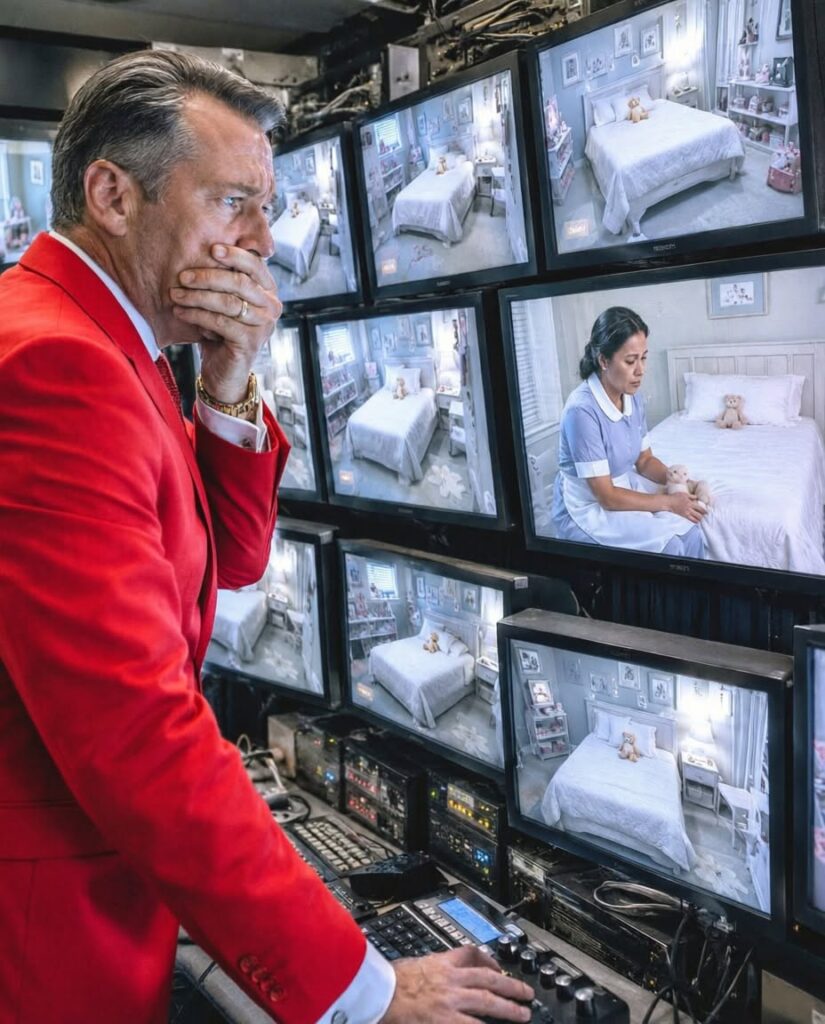
The billionaire pretended to go to Europe. But what he saw on the hidden cameras between his housekeeper and his daughters left him frozen.
The billionaire turned off the lights in his mansion, picked up his suitcase, and kissed his daughters goodbye, as if nothing had happened.
“I’ll only be gone for a few days,” he told them with a calm smile. “Be good.”
The girls hugged him tightly. They had no idea he was lying.
The plane never took off. There was no business trip. No Europe. No hotel suite waiting for him abroad.
Instead, less than an hour after his car left through the front door, the most powerful man in the city returned home through the back door, in complete silence, with only his head of security by his side.
He wasn’t there to surprise anyone.
He was there to observe.
Because the poison had already been planted.
The night before, his fiancée had leaned across the table, lowered her voice, and whispered something that had stayed with him.
“You trust that maid too much,” Patricia had said softly. “She’s stealing from you. And worse — she’s manipulating your daughters.”
That phrase haunted him all night. Not because he immediately believed it. Because a part of him feared it was true.
For years, Emiliano Duarte had trusted the young woman who cleaned his house and looked after his daughters when he was away. Rosa had always been quiet, careful, respectful. The kind of person most wealthy families never truly saw. She moved through the house like a shadow, never seeking attention, never meddling where she didn’t belong.
But Patricia had started making small comments. At first, they seemed harmless. Then they began to accumulate.
I realized one of my bracelets wasn’t where I’d left it.
The girls seem more attached to her than to anyone else.
She’s too comfortable here.
She knows too much.
She acts like she doesn’t exist — and those are the dangerous ones.
Doubt is strange. It doesn’t break down the door. It slips through the cracks. And once inside, it starts to change everything.
Soon Emiliano found himself reliving moments that had never bothered him before. The way Rosa knew exactly how Martina liked her sandwiches. The way Daniela would run to meet her first thing after school. The way both girls seemed more at ease with Rosa than with anyone else in the house.
Before Patricia’s accusations, those things had seemed like kindness.
Afterward, they looked different.
So Emiliano made a decision. During dinner, he announced a last-minute trip to Europe.
Daniela looked up first. “Again?” The disappointment in her voice resonated more strongly than if she had shouted.
Martina remained silent. She simply gripped her spoon and stared at her plate.
“Just a few days,” he said.
Patricia smiled beside him and took his hand under the table like the perfect future wife.
Rosa stood near the kitchen entrance, silently clearing the table, her expression unreadable.
The next morning, Emiliano kissed both daughters on the forehead, forced a smile, and got into the car.
As it drove away, he glanced back through the tinted window.
The girls stood on the doorstep watching him leave. Behind them, Rosa held a breakfast tray and lowered her gaze respectfully when she noticed him watching.
An ordinary goodbye.
Thirty minutes later, he had returned through the service entrance.
In the monitoring room, a wall of screens lit the darkness. Every room. Every angle. Every corner of the house he had built and somehow never fully understood.
For a few minutes, nothing seemed unusual. Rosa cleared the table. The girls finished their milk. Everything painfully normal.
Then the front door clicked shut after the last morning employee left.
And Patricia appeared in the living room.
The change in her face was instantaneous.
No warm smile. No refined grace. The sweetness gone — replaced by something cold, sharp, impatient.
Daniela sat on the rug with a book. Martina clutched a stuffed rabbit.
Patricia approached slowly. “What did I tell you about sitting here?”
Both girls jumped.
They weren’t scared.
They were conditioned.
Patricia snatched the rabbit from Martina’s hands and threw it onto the sofa. “When your father isn’t around, you’ll do what I say the first time.”
Martina’s lip trembled. Daniela moved closer to her sister.
Then Rosa entered.
She came quietly, without aggression, simply standing between Patricia and the girls.
“Miss Patricia,” Rosa said gently. “The girls haven’t done anything wrong.”
Patricia turned so quickly it almost seemed violent. “Did I ask for your opinion?”
“No, ma’am.”
“Then remember your place.”
In the monitoring room, Emiliano stared at one detail longer than anything else.
Not the argument. Not Patricia’s face. Not even Rosa’s intervention.
It was the way Daniela reached for Martina’s hand.
As if this had happened before. As if they already knew how to prepare for it.
And suddenly Emiliano understood why his daughters had grown quieter. Why they looked at him with that strange mixture of love and distance. Why the house had felt colder long before he admitted it.
For months, Patricia had been whispering that Rosa was dangerous.
He had never once wondered what his daughters were afraid of.
What does Emiliano do the moment he steps out of that monitoring room — and what does Rosa know that Patricia never wanted him to find out? Full story in the comments 👇
FULL STORY
He sat in the dark for eleven more minutes.
Not because he needed more evidence. He had seen enough in the first forty seconds after Patricia’s mask came off. He sat because he needed to be certain of himself before he moved — because a man who reacts from anger makes mistakes, and Emiliano Duarte had not built what he’d built by making mistakes.
His head of security, Marco, stood beside him without speaking. Marco had worked for him for nine years and understood, among other things, when silence was the appropriate response.
On the screens, Patricia had arranged herself on the living room sofa with her phone, composed again, the mask back in place. Rosa was in the kitchen. The girls had retreated upstairs, Martina still without her rabbit.
“I need two things,” Emiliano said quietly. “I need you to go upstairs and give Martina her rabbit back. And I need you to make sure Rosa does not leave the house today.”
“And Miss Patricia?”
Emiliano stood.
“Miss Patricia,” he said, “is going to stay exactly where she is.”
He came through the main hallway without announcing himself.
Patricia heard his footsteps first. He watched her face process the sound — confusion, then recalibration, then the smile arriving in position just before he appeared in the doorway.
“Emiliano.” A perfect surprise. “What happened to the flight?”
“I turned back,” he said. “Something felt wrong.”
“Wrong how?” The smile stayed. Practiced.
“I’m not sure yet.” He sat across from her. “How are the girls?”
“Wonderful. We’ve been having a lovely morning.”
He looked at her for a long moment.
Patricia had a remarkable face. It was the first thing he’d noticed about her — the architecture of it, the way it arranged itself into whatever the room required. He had read it as adaptability. As social intelligence. As the particular skill of someone who understood people.
He understood now that he had been reading the instrument, not the music.
“Patricia,” he said. “I need to ask you something directly.”
“Of course.” She set her phone facedown on the sofa cushion.
“How long have you been speaking to the girls the way I saw you speaking to them this morning?”
The smile didn’t move.
“I don’t know what you mean.”
“The rabbit,” he said. “Martina’s rabbit.”
One beat. Barely perceptible. Then: “She was being difficult. I was setting a boundary. Children need—”
“You threw it across the room.”
The smile held for another second. Then it reorganized into something softer, more injured.
“I raised my voice,” she said. “I’m not perfect. I apologized to her immediately after.”
“She didn’t look like someone who had received an apology.”
“Children dramatize.”
Emiliano looked at the sofa cushion where the phone lay facedown and thought about the bracelet Patricia had mentioned three weeks ago. The one she’d said had been misplaced. The one she’d implied Rosa had moved.
“Did you find your bracelet?” he asked.
A flicker. “Which one?”
“The one you mentioned. The one you thought Rosa had moved.”
“Oh.” Dismissive. “Yes, it turned out I’d left it in the bathroom. A mistake.”
“You didn’t tell me that.”
“It wasn’t important.”
He nodded slowly.
“Rosa has been with us for four years,” he said.
“I know.”
“She has never given me a reason to question her.”
“Emiliano.” Patricia’s voice shifted into the register she used when she wanted to seem like the reasonable one in a conversation where she felt cornered. “I understand you’re loyal to her. That’s admirable. But sometimes we can’t see clearly when we’re too close to something.”
“That’s true,” he said.
She relaxed slightly.
“It’s also true,” he said, “that I’ve been watching the cameras for the last hour.”
The relaxation left her body so completely it looked like a physical thing departing.
“The monitoring room,” he said. “I watched from the moment I came back through the service entrance.” He waited. “Would you like to tell me what I saw, or would you like me to tell you?”
Patricia’s face did something he had never seen it do before.
It went entirely still.
Not the controlled stillness of someone composing herself. The stillness of a person who has just understood that the architecture they built has a camera in every room.
Rosa knocked on the study door twenty minutes later, at Marco’s request.
She came in with the careful posture she always carried — not submissive, just precise, the posture of someone who had learned to take up the exact right amount of space.
“Mr. Duarte,” she said.
“Sit down, Rosa.”
She sat.
“I owe you an apology,” he said.
She looked at him without speaking.
“I listened to things I should have questioned,” he said. “I put you in a position where someone with bad intentions could direct suspicion at you, and I didn’t push back the way I should have.” He kept his voice even. “That was a failure of judgment on my part.”
Rosa was quiet for a moment.
“How much did you see?” she asked.
“Enough.”
She nodded once, looking at her hands.
“How long?” he asked.
“The way she speaks to them when you’re not present,” Rosa said carefully, “began approximately three months after you announced the engagement.” She paused. “At first it was small things. Instructions that contradicted yours. Corrections in a tone that — I don’t have another word for it except unkind.” She looked up. “I tried to speak with you once. You were traveling. She told me afterward that if I raised concerns about her to you directly, she would make sure I lost my position.”
“Why didn’t you tell me anyway?”
“Because I needed this job,” Rosa said. Simply. Without self-pity. “I have my mother’s medical bills and a sister in school and I — ” She stopped. “That was wrong of me. I should have found a way.”
“You protected them the only way you could,” he said.
“It wasn’t enough.”
“It was something,” he said. “And now I’m asking you to tell me everything. From the beginning.”
She did.
It took forty minutes. Rosa had a precise memory — dates, words, incidents, the specific afternoon Patricia had taken Martina’s drawing off the refrigerator and dropped it in the recycling bin while telling her that “clutter makes the house look poor.” The evening she had told Daniela that her father preferred quiet children, that his first daughter — a daughter Emiliano did not have — had been better behaved.
That last one landed differently than the others.
“She told Daniela I had a first daughter,” he said.
“Yes.”
“Where did that come from?”
Rosa looked at him.
“I don’t know,” she said. “But Daniela asked me about it afterward. She seemed genuinely confused about whether it was true.”
Emiliano thought about Daniela’s face at dinner lately. The careful way she chose her words. The questions she had stopped asking.
“She’s been testing the girls,” he said.
“Yes,” Rosa said. “Testing what they’d believe. What they’d accept. What they’d repeat to you.”
He was quiet for a moment.
“Did they repeat things to me?”
“Daniela tried once,” Rosa said. “About two months ago. She told you at breakfast that Patricia had said you didn’t like noise at home. You told her you didn’t know where she’d heard that.” Rosa paused. “After you left for work that morning, Patricia told her that children who made up stories were difficult to trust.”
He closed his eyes briefly.
He remembered that breakfast. He had been distracted. A board meeting. A deadline. He had told Daniela she must have misheard something and moved on to his coffee.
He had moved on to his coffee.
Patricia left that afternoon.
Not dramatically — Emiliano had specifically decided against drama, because drama was her environment, the medium in which she performed best. He called his attorney, confirmed what the cameras had captured was legally sufficient to terminate the engagement agreement without financial penalty to him, and then went to find Patricia in the guest suite where she had retreated after their conversation.
“I need you to leave today,” he said. “I’ll have someone assist with your things.”
“Emiliano.” She stood. The injured register again. “You’re making a decision based on a hidden camera. That’s not who you are.”
“The camera showed me who I am,” he said. “A father who wasn’t paying attention.” He looked at her. “That changes today. You leaving is the first part of that change.”
“I love you.”
“I believe you believe that,” he said. “But you were cruel to my daughters and manipulative with my staff and you spent months constructing a false case against someone whose only offense was protecting the people I should have been protecting myself.” He moved to the door. “Marco will help you with anything you need.”
“You’ll regret this.”
“Possibly,” he said. “But not for the reasons you think.”
He closed the door.
That evening, after Patricia’s car had left the driveway, Emiliano went upstairs.
Martina was in her room, the rabbit restored to her arms by Marco that morning, sitting on the floor with a coloring book.
She looked up when he came in.
He sat on the floor beside her. Not on the chair. On the floor.
“Hi, bug,” he said.
“Hi, Dad.” Cautious. Still calibrating what version of him had returned.
“I’m sorry I’ve been away so much,” he said.
She colored for a moment without answering.
“Are you actually back?” she asked. “Or just for a few days?”
The precision of the question hit him somewhere between the ribs.
“Actually back,” he said.
She looked at him. Then at the rabbit. Then back at him.
“Patricia’s gone,” she said. Not a question.
“Yes.”
She went back to her coloring.
A minute passed.
“She threw Mr. Rabbit,” Martina said.
“I know,” he said. “I saw.”
“You weren’t here.”
“I was watching,” he said. “I should have been here. That’s different. But I was watching.”
Martina considered this with the gravity of a seven-year-old adjudicating something important.
“Okay,” she said finally.
And slid the coloring book toward him.
“You can do the sky,” she said. “But don’t make it purple. Daniela always makes it purple and it’s wrong.”
He picked up a blue crayon.
“Blue,” he said.
“Blue,” she confirmed.
Daniela took longer to trust.
She was ten, and ten was old enough to have noticed more and processed it differently, and she had been told enough small untruths that she had begun applying a discount to everything she heard, including reassurances.
Emiliano did not push. He showed up consistently — at dinner, at school pickup twice a week, at the Saturday morning market she had always loved and he had always been too busy to attend. He was there, repeatedly, in the unremarkable ways that accumulate into evidence of a different kind.
Three weeks after Patricia left, Daniela came to his study while he was working and stood in the doorway.
“Rosa’s still here,” she said.
“Yes.”
“Patricia said you were going to let her go.”
“Patricia was wrong,” he said. “Rosa stays as long as she wants to.”
Daniela looked at the floor.
“She protected us,” she said. “When you weren’t here.”
“I know,” he said. “I owe her a great deal.”
“You owe us an apology too,” Daniela said.
He looked at his daughter — her mother’s directness in her father’s house, ten years old and completely correct.
“Yes,” he said. “I do.”
He pushed his chair back from the desk.
“Come sit with me,” he said. “And I’ll start.”
She came in and sat across from him. Pulled her feet up beneath her, the way she always did when she was settling in for something serious.
He apologized. Not the efficient, corporate version. The real one, which took longer and required him to say specific things out loud that were uncomfortable to say — that he had listened to someone he should have questioned, that he had let distance become habit, that he had missed things he should have seen because seeing them would have required him to be present in ways he had chosen not to be.
Daniela listened.
When he finished, she was quiet for a moment.
“Are you going to do it again?” she asked.
“Get engaged to someone who isn’t good?”
“Get so busy you don’t notice what’s happening at home.”
He looked at her.
“I’m going to try not to,” he said. “And when I start to, I need you to tell me.”
She considered this.
“Okay,” she said. “But I need you to actually listen.”
“Deal,” he said.
She uncurled her feet and stood.
“Rosa’s making that soup tonight,” she said. “The one with the dumplings. You should eat with us.”
“I will,” he said.
She left.
He sat in his study for a moment, in the house that had felt colder than he’d admitted for longer than he’d been willing to say, and thought about the monitoring room and the wall of screens and the small detail he had fixated on above all the others.
The way Daniela had reached for Martina’s hand.
As if they already knew how to take care of each other.
They had learned that in his absence.
He could not undo the learning.
But he could make sure they never needed it again.
Rosa received a formal contract revision the following month.
New title. New salary. An employment agreement that specified her role, her authority in the household, and her right to raise concerns directly to Emiliano through a documented channel that could not be intercepted or threatened.
She read it twice at the kitchen table while Emiliano stood near the counter pretending to check his phone.
“This is significantly more than I expected,” she said.
“It reflects what you actually do,” he said. “What you’ve been doing without adequate acknowledgment.”
She looked at the contract.
“The clause about speaking directly to you,” she said.
“Yes.”
“If there is ever another situation—”
“There won’t be,” he said. “But if there is, you come to me.”
She nodded slowly.
“My mother’s next treatment is in March,” she said. Not asking for anything. Just saying it.
“The health coverage in the contract includes dependents,” he said. “Your mother qualifies.”
Rosa looked up.
He went back to looking at his phone.
“Thank you, Mr. Duarte,” she said.
“Thank you,” he said. “For the dumplings. And for everything before them.”
On a Saturday in late autumn, Emiliano sat at the kitchen table with both daughters while Rosa made breakfast and the house held the particular warmth of a place where nothing was being performed.
Martina was explaining, with great authority, why the rabbit’s name was Mr. Rabbit and not anything more creative.
“Because that’s what he is,” she said. “He’s a rabbit. The Mr. is respectful.”
“Respectful to whom?” Daniela asked.
“To the rabbit.”
Daniela looked at her father. “Do you see what I deal with?”
“I do,” he said. “I also think Mr. Rabbit is an excellent name.”
Martina pointed at him. “Thank you.”
Rosa set plates on the table without comment, but he caught the slight curve at the corner of her mouth.
Outside, the garden caught the morning light. The house smelled of coffee and something warm and ordinary. His daughters were arguing about the correct way to show respect to stuffed animals.
For months, he had been the most powerful man in the city who could not see what was happening in his own kitchen.
He could see it now.
He intended to keep looking. 💙
Sometimes the most dangerous person in the room is the one rearranging what you see before you look. Have you ever realized too late — but just in time — that you’d been looking in the wrong direction? Share below 👇