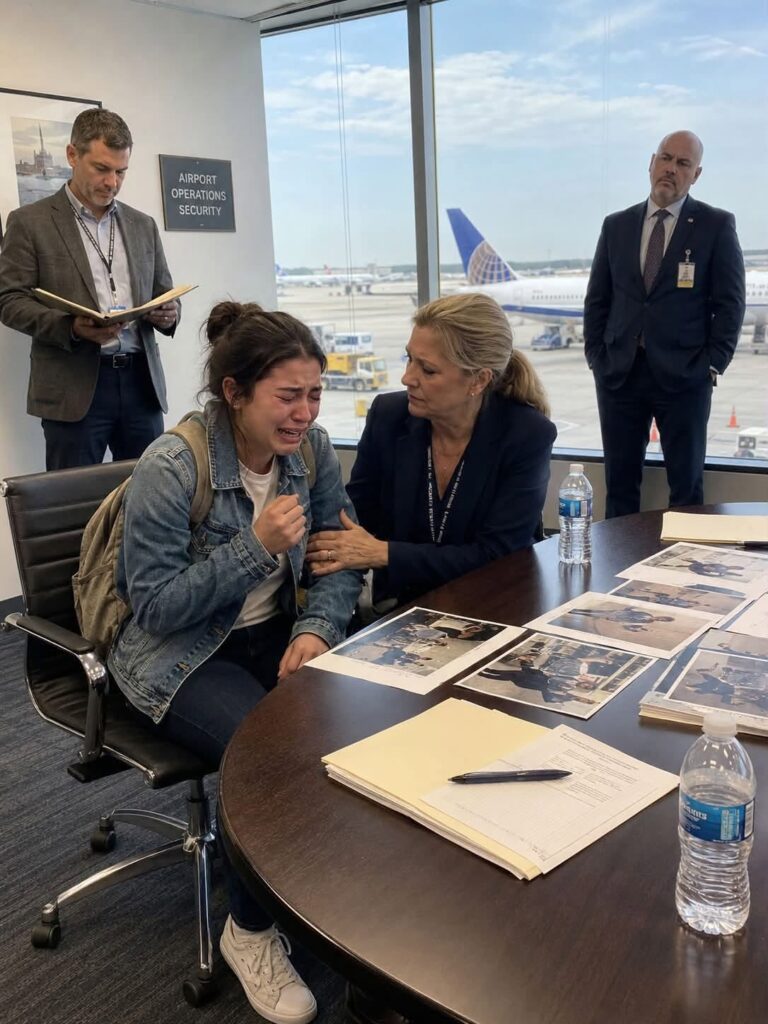
While I was on vacation with my cousins, my phone lit up with one message: “Get on a plane home. Don’t tell your parents you’re coming.”
When I landed, an attorney and two investigators were waiting for me at the airport — and the truth they revealed was so shocking my knees gave out.
I was in Florida with my cousins when the message arrived.
We had spent the morning pretending we were kids again — barefoot on the beach, sunscreen across our noses, laughing too loudly over shaved ice and terrible vacation photos. I was twenty-three, old enough to pay my own rent in Seattle, but still young enough that a week with my cousins felt like stepping out of my real life.
My phone buzzed on the towel beside me.
The message was from my father’s older sister, Aunt Rebecca.
Get on a plane home. Don’t tell your parents you’re coming.
I stared at it until the words stopped making sense.
My cousin Emma leaned closer. “Everything okay?”
I typed back: What happened?
Three dots appeared.
Disappeared.
Appeared again.
I can’t explain by text. Your ticket is at the counter. Use your passport. Go now, Claire. Please.
That was the part that made my stomach twist.
Aunt Rebecca never said please unless something terrible had happened.
By sunset, I was on a flight to Seattle with my damp swimsuit shoved into my carry-on and my cousins calling after me from the curb, telling me to text when I landed. I did not tell my parents. I almost did six different times. My thumb hovered over my mother’s contact until the plane rose above the clouds and service disappeared.
When I landed, I expected to see Aunt Rebecca.
Instead, two men and one woman stood near baggage claim holding a paper sign with my full name.
CLAIRE ELLISON.
The woman had silver hair pinned into a knot and a leather briefcase tucked beneath one arm. “Claire?” she asked softly.
“Yes.”
“My name is Margaret Shaw. I’m an attorney.” She motioned toward the men beside her. “This is Investigator Daniel Price and Investigator Luis Ortega. We need to speak somewhere private.”
My mouth went dry. “Is this about my parents?”
Margaret’s expression shifted just enough to answer before she said anything.
“It is.”
In a small airport conference room, Daniel set a folder on the table.
Inside were photographs.
Bank records.
Copies of birth certificates.
A newspaper clipping from twenty-one years earlier.
Margaret folded her hands.
“Claire, the people who raised you, Martin and Elaine Ellison, are not your biological parents.”
I laughed once, because my brain could not accept the sentence any other way.
Then Daniel slid the newspaper clipping toward me.
LOCAL COUPLE KILLED IN HIGHWAY COLLISION. INFANT DAUGHTER MISSING FROM WRECKAGE.
A baby photo was printed beneath the headline.
My face.
Smaller, rounder, but mine.
Margaret’s voice stayed steady. “Your birth name is Natalie Pierce. Your parents were David and Laura Pierce. They died in a crash outside Tacoma. You were reported missing from the scene.”
The room tilted.
Luis said, “We believe Martin Ellison was one of the first officers to arrive.”
“My dad?” I whispered.
Daniel opened another photograph.
My father, younger, in uniform, standing beside the wrecked car.
Margaret said, “He never reported finding you.”
I tried to stand, but my knees gave out before I made it halfway up.
PART 2
My hands would not stop shaking.
I pressed them flat against the table, but the trembling moved up my arms anyway.
“How long have you known?” I asked.
Margaret opened the briefcase. “The investigation began fourteen months ago. A cold case unit in Tacoma reopened the Pierce file when a highway database was digitized. Your infant footprint from the scene was matched against hospital records.” She paused. “You were never admitted to any hospital that night. You simply disappeared.”
“My father was a cop.”
“He was the first officer on scene,” Daniel said. “He filed a report stating no survivors. He listed the infant status as unknown.”
“Unknown.” The word tasted like something rotting. “I was right there.”
“Yes.”
I looked at the baby photo again. Round cheeks. Dark eyes. A face I had seen in my own mirror every morning for twenty-three years without knowing what it meant.
“Where did they tell people I came from?” My voice came out flat. Strange. Like it belonged to someone standing just behind me.
Margaret said, “Your parents — the Ellisons — moved from Tacoma to Seattle four months after the accident. They registered you in the school system as Claire Ellison, born in Portland. There was a falsified birth certificate.”
“He made one.”
“Yes.”
“My father made a fake birth certificate.” I said it out loud because I needed to hear how it sounded. “And my mother—”
“Elaine Ellison was aware. We have phone records. Emails between her and your father from that period discussing the — arrangement.”
Arrangement.
They called me an arrangement.
Luis leaned forward. “Claire, we need to ask you something before we go any further. Is there anything in your childhood — anything your parents said or did — that felt wrong to you? Anything you were told not to question?”
I almost said no.
Then I remembered the box.
The locked gray box in my father’s office that I was never allowed to touch. That I had asked about once when I was nine and my father’s face had gone so still and cold that I never asked again.
“There’s a box,” I said. “In his office. He keeps it locked.”
Daniel and Luis exchanged a look.
“We’re going to need you to help us get inside that house,” Margaret said.
My stomach dropped.
Because I understood what she was not saying.
My parents did not know I was coming. And whatever was in that box, my father had kept it locked for twenty-three years.
The question was not whether it was still there.
The question was whether I was ready to open it.
What’s inside that locked box — and what will Claire’s father do when he sees her walk through that door? Click the link below to read the full story. The truth is worse than anyone in that airport room was prepared for.
PART 3
The drive to my parents’ house took nineteen minutes.
I counted every one of them.
Margaret sat beside me in the back seat. Daniel drove. Luis watched the side mirror like he expected someone to follow us.
“What happens if he destroys the box before we get there?” I asked.
“He doesn’t know we’re coming,” Daniel said.
“He doesn’t know I’m coming,” I said. “That’s different.”
Nobody answered. Because they knew I was right.
The house looked exactly the same. White siding. Blue shutters. The rosebush my mother planted the year I turned ten, still growing along the left side of the porch. A light on in the kitchen window.
Normal. Perfectly, carefully normal.
My legs did not want to move when the car stopped.
“You don’t have to go in first,” Margaret said.
“Yes I do.” I opened the door. “He won’t let you past the porch without me.”
I rang the doorbell.
I had a key. I had used it ten thousand times. But something in me refused to use it now. Some part of me that understood this was not my house anymore.
Footsteps. My mother’s footsteps — I knew the rhythm of them like a song.
The door opened.
Elaine Ellison looked at me the way you look at something you have been dreading for years and finally see standing on your front porch.
Not surprised.
Relieved, almost. In the way that people are relieved when a long lie finally ends.
“Claire,” she said.
“Mom.” The word came out before I could stop it. Old habit. Twenty-three years of muscle memory. “I need to come inside.”
Her eyes moved to Margaret and the two investigators behind me.
Her face went the color of old paper.
“Martin,” she called. Her voice barely carried. “Martin, come to the door.”
His footsteps were heavier. Slower. The footsteps of a man who had spent twenty-three years waiting for exactly this sound — his wife’s voice calling him to the door in that specific tone.
My father appeared behind her.
He was sixty-one years old. Broad shoulders going soft. Gray at his temples. The face I had called Dad my entire life.
He looked at Margaret’s briefcase. At Daniel’s jacket. At Luis standing slightly to the side, watching the street.
Then he looked at me.
“Hey, bug,” he said. His voice was steady. His eyes were not.
“Don’t,” I said.
His jaw tightened.
“Let us in, Mr. Ellison,” Margaret said. “Or we can have this conversation on the porch.”
He stepped back. My mother moved to the side. I walked into the house that had been my whole world for twenty-three years and tried to remember how to breathe.
We sat in the living room. My parents on the couch. Me in the chair across from them. Margaret beside me. Daniel and Luis near the door.
My father’s eyes had not left my face since I walked in.
“You already know why we’re here,” Margaret said.
“I’d like to hear you say it,” my father said.
“Martin.” My mother’s voice cracked on the single word.
“Let them say it, Elaine.”
Margaret opened the briefcase. She set the newspaper clipping on the coffee table between us. LOCAL COUPLE KILLED IN HIGHWAY COLLISION. INFANT DAUGHTER MISSING FROM WRECKAGE.
My father looked at it for a long time.
He did not deny it. He did not reach for it. He simply looked at it the way you look at something you have been carrying for so long that seeing it outside your own head feels almost surreal.
“You were the first officer on scene,” Margaret said.
“Yes.”
“You found an infant.”
“Yes.”
“And you did not report her.”
Silence.
“Dad.” My voice cracked the silence like a stone through glass. “Say it. Say it out loud. In front of me.”
He finally looked up from the clipping.
“I found you in the backseat,” he said. “You were in your car seat. Not a scratch on you. Your parents—” He stopped. Swallowed. “David and Laura were already gone. The car had gone through the guardrail. There was no one else at the scene yet. Just me.”
“So you took me.”
“I called it in as no survivors.”
“You took me, Dad. Say it like what it was.”
His jaw worked. “I took you home.”
“You st*le me.”
The word hit the room like a physical thing.
My mother made a sound. My father’s expression did not change, but something behind his eyes did — something that had been braced for twenty-three years finally gave way.
“Is that what you think?” he asked.
“That’s what it was.”
“Elaine had just lost our third pregnancy,” he said. His voice was quiet. Controlled. The voice of a man who had rehearsed this explanation so many times it had worn smooth. “Three losses in four years. The doctors said she couldn’t carry to term. We had been through the adoption system for two years and been turned down twice. And then I found you. Alone. In a wrecked car. In the rain.”
“That’s not a reason,” I said.
“I know that.”
“Then why are you saying it like it is one?”
He had no answer for that.
“The box,” Daniel said from near the door. “We need to see what’s in the box, Mr. Ellison.”
My father’s eyes moved to Daniel. Something shifted in his expression. Something I had never seen there before.
Fear.
Real fear. Not the controlled discomfort of a man caught in an embarrassing lie. The fear of a man who knows that one specific thing — that one locked thing — changes the shape of everything.
“What box?” my mother asked.
My father said nothing.
“Martin, what box?”
“It’s in his office,” I said. “The gray one. The one I was never allowed to touch.”
My mother turned to look at my father. And in the way she turned — the slight stiffening, the small intake of breath — I understood that she did not know about the box either.
All those years. The same house. The same marriage. And she did not know.
“Martin.” Her voice was different now. Smaller. “What’s in the box?”
“Nothing that changes anything,” he said.
“Let us determine that,” Margaret said.
My father stood up. “I’d like to speak with a lawyer before—”
“You can call one from the office,” Daniel said. “But we have a warrant for the contents of the premises, Mr. Ellison. Issued this morning.”
My father looked at me. One long look. The look of a man trying to find the version of his daughter who would still choose him.
I did not give it to him.
“Show them the box, Dad.”
The office was exactly as I remembered it. Dark wood desk. Diplomas on the wall from his time on the force. A photograph of the two of us at my college graduation, him with his arm around me, both of us squinting into the sun.
The box was on the bottom shelf of the bookcase. Right where it had always been.
Gray metal. A combination lock. Scratched at the edges from years of handling.
My father stood in the doorway.
Daniel looked at him. “The combination, Mr. Ellison.”
Silence.
“We can have it opened by a technician,” Luis said. “It takes about four minutes.”
My father crossed his arms. “I want my lawyer present.”
“That’s your right,” Margaret said. “We’ll wait.”
Forty minutes. That was how long it took for his lawyer to arrive. A man named Gerald Fitch, who wore a gray suit and had the expression of someone who had already heard the summary on the phone and was not happy about any of it.
Gerald pulled my father into the hallway. I sat in the office chair and looked at the box.
My mother stood in the corner of the room.
She had not said anything since we left the living room.
“Did you know?” I asked her.
She did not answer right away.
“About the box.”
“No,” she said. Then, quietly: “About you — yes. About everything else — no.”
“What does that mean? What’s everything else?”
She pressed her lips together.
“Mom. What is in that box?”
“I don’t know, Claire. I genuinely do not know.”
“But you know it exists.”
Her hands twisted in her lap. “I knew he kept something locked. I assumed it was paperwork. Things from the night he found you. I never asked because I was afraid of what asking would mean.”
“You were afraid it would make it real.”
“It was already real.” Her voice broke on the last word. “It has been real every single day for twenty-three years. Every school play. Every birthday. Every time you called me Mom. It was real.”
I wanted to feel something clean. Anger. Grief. Something with a single edge.
Instead I felt all of it at once, layered on top of each other until I couldn’t tell one from the next.
“I’m not your daughter,” I said.
She flinched like I had struck her.
“I know,” she whispered.
“I’m Natalie Pierce.”
“You’re Claire.” Her voice steadied. “Whatever else is true — you are Claire. You have been Claire every day of your life and I have loved every single day of it. Whatever Martin did. Whatever is in that box. That part is real.”
I had no answer for that.
Gerald came back into the room. My father followed, his face closed and careful.
“He’ll open the box,” Gerald said. “Under protest.”
My father crouched in front of the bookcase. His fingers moved to the combination. I watched his hands — the same hands that had helped me learn to ride a bike, that had held me when I had my tonsils out at seven, that had walked me across the stage at my college graduation.
The lock clicked open.
He stood back.
Daniel stepped forward and lifted the lid.
Inside: a manila envelope, thick with papers. A small cloth bag. A USB drive. And beneath everything else, a child’s hospital bracelet. Tiny. The kind they put on infants in the maternity ward.
The name on the bracelet read: BABY GIRL PIERCE.
Margaret picked up the envelope and opened it.
I watched her face as she read.
Something changed on it. Something I could not name but recognized immediately as bad news of a specific kind — not shocking, but confirming.
“Mr. Ellison,” she said without looking up. “Were you aware that David Pierce had a life insurance policy?”
My father said nothing.
“Were you aware that this policy named his infant daughter — Natalie Pierce — as sole beneficiary?”
My mother made a sound.
“Were you aware,” Margaret said, her voice still steady, still controlled, “that this policy has been accruing for twenty-one years because it was never claimed?”
The room went absolutely silent.
“How much?” I asked.
Margaret looked at me. “The principal was four hundred thousand dollars. With twenty-one years of interest—” She checked the document. “The current value is approximately one point two million dollars.”
My mother turned to my father.
“Martin.” Her voice was barely a sound. “Did you know about the money?”
He said nothing.
“Martin.”
“It doesn’t matter,” he said.
“It matters,” Margaret said. “Because if he knew about the policy at the time he removed you from the scene, the charge changes. It is no longer a matter of a desperate man making a terrible decision in a moment of grief. It becomes something else.”
“What does it become?” I asked.
“It becomes evidence of motive.”
The word landed in the room like something dropped from a very great height.
My mother stood up from her chair. Slowly. The way a person stands when the floor beneath them has fundamentally changed and they are not yet sure it will hold their weight.
“You knew about the money,” she said.
“Elaine—”
“Tell me the truth. Right now. You owe me that. Did you know about the policy when you took her?”
My father looked at his lawyer. Gerald gave a small, almost imperceptible shake of his head.
“Don’t do that,” my mother said. “Don’t look at him. Look at me. I have been your wife for thirty years. I raised that child with you. I have carried this secret every single day because I believed you when you said you did it for us. For me. Because of what we had lost.” Her voice cracked and rebuilt itself in the same breath. “Was it for us? Or was it for the money?”
Silence.
“Answer me, Martin.”
“It was complicated,” he said.
My mother sat back down. Not because she was calm. Because her legs stopped working the same way mine had at the airport.
“Get out,” she said.
“Elaine—”
“Get out of this room. Get out. I can’t look at you right now.”
Gerald touched my father’s arm. My father looked at me one more time — that same searching look, still hoping to find something — and then he turned and walked out of the room.
Margaret called someone from the hallway. Luis followed my father to another room. Daniel stayed near the door.
My mother and I sat in the office with the gray box open between us.
I picked up the hospital bracelet. It was lighter than I expected. Something this small to hold a whole identity.
BABY GIRL PIERCE.
“I had a name,” I said.
“I know.”
“Natalie.”
My mother nodded.
“Did he ever tell you my real name?”
“No.” Her voice was very quiet. “He brought you home and told me to choose a name for you. He said the baby’s parents had not survived and there was no family to claim her. He said the system would take you and split you through foster care and he couldn’t leave you there.” She looked at the bracelet in my hands. “I chose Claire. Because my grandmother’s name was Claire and I had always wanted a daughter by that name.” She stopped. “I didn’t know he had taken anything from the scene. I didn’t know about any of this.”
I believed her. I did not know if believing her made anything easier, but I believed her.
“What happens now?” she asked.
“I don’t know.”
“To you, I mean. What do you want to happen?”
I thought about that. The money. The name. The grave somewhere in Tacoma with two people in it who had loved me for eleven months and then been gone.
“I want to find out if I have any other family,” I said. “My birth parents. Grandparents. Anyone.”
“Your grandmother is alive,” Margaret said from the doorway.
Both of us turned.
“Laura Pierce’s mother. Her name is Ruth Calloway. She lives in Tacoma.” Margaret came into the room and sat down. “She reported you missing the night of the accident. She has been searching for you for twenty-one years. She hired the private investigators who eventually brought this case to us.”
The room tilted again.
“She’s been looking for me.”
“She never stopped.”
I set the hospital bracelet carefully back into the box.
“Does she know you found me?”
“She knows we found the file. She doesn’t know we found you. Not yet.”
“Why not?”
“Because we wanted to speak with you first. This is your information, Claire. Your life. You decide what happens next.”
I sat with that for a moment. The unfamiliar weight of it. Being the one who decides.
For twenty-three years, a decision had been made for me. My name. My family. My entire life. Someone had opened a door and placed me on one specific path and locked every other possibility behind me.
And now a woman in Tacoma had spent twenty-one years trying to pick that lock.
“Call her,” I said.
Margaret made the call from the kitchen. She kept her voice low, but the house was quiet enough that I caught fragments.
Yes. She’s here. She’s safe. Are you—
A pause.
I’ll put her on.
Margaret appeared in the doorway holding her phone out to me.
I walked to her and took it.
I held it against my ear.
“Hello?” The voice on the other end was older. Careful. Like someone who had rehearsed a word so many times it had almost lost its meaning and was now being used for real and suddenly felt enormous.
“This is Claire,” I said. Then I stopped. “I mean — I’m Natalie. I think. I don’t — I’m sorry. I don’t know what to call myself right now.”
A sharp breath on the other end.
“You don’t have to call yourself anything right now,” the voice said. “I’ve been calling you by your name for twenty-one years. I can wait a little longer.”
Something broke open in my chest.
Not dramatically. Not like a crack or a snap.
Like a window that had been painted shut for a very long time being gently, carefully pushed open.
“My parents,” I said. “David and Laura. Did they—” I didn’t know how to finish the question.
“They loved you from the moment we knew you were coming,” Ruth said. “Your father used to talk to you before you were born. Standing in the kitchen making breakfast, just talking to you like you were already there. Your mother kept a journal from the day she found out. Every single day.”
“Does the journal—”
“I have it,” Ruth said. “I’ve had it for twenty-one years. I’ve been keeping it for you.”
I sat down on the kitchen floor. Not because I planned to. Because my legs made the decision first.
Margaret crouched beside me.
I kept the phone against my ear.
“I have so many questions,” I said.
“I know,” Ruth said. “So do I.” A pause. “Would you — could you come to Tacoma? When you’re ready. No rush. I just — I would very much like to see your face.”
“I’ll come,” I said. “I’ll come soon.”
My father was arrested three days later.
The charges were significant. Filing a false police report. Obstruction of justice. Interference with a custody determination. And because of the insurance policy and the evidence on the USB drive — financial fraud tied to a minor’s estate.
The USB drive contained records. My father had known about the Pierce life insurance policy within forty-eight hours of the accident. He had tracked its status for years. He had never intended to claim it — the risk was too high — but he had watched it. Checked it. Kept a record of a sum of money that belonged to me and that he could never touch without exposing everything.
Gerald Fitch issued a statement saying his client acted out of love and grief and had never financially benefited from the situation.
Margaret read the statement and said nothing.
I read it and thought about the USB drive. About a man who spent twenty-one years monitoring an account he knew was mine and doing nothing.
Love and grief. Maybe. Probably. Both things true at once.
And also a lie maintained for twenty-three years, and a box kept locked, and a baby bracelet hidden on a shelf.
My mother cooperated fully with the investigators. She gave them every document she had. Every email. Every record of what she knew and when she knew it. Her lawyer said full cooperation was her best path. Her conscience, I think, agreed.
She called me two weeks after the arrest.
I almost didn’t pick up.
I picked up.
“I’m not asking for anything,” she said. “I just wanted you to know that I have been thinking about what you said. About being Natalie Pierce.”
“And?”
“And I think you are both people. I think you get to be both.” Her voice was careful. Not scripted. Careful in the way of someone trying hard to say exactly what they mean. “Claire is real. Everything we lived together is real. But Natalie is also real. And she deserves to be found.”
I did not know what to say to that.
“You don’t have to forgive us,” she said. “I’m not asking for that. I know what Martin did. I know what I did by staying silent. I know it changed your whole life without your permission.” A long pause. “I just wanted you to know that I loved you. Every day. Whatever that’s worth to you now.”
“I know,” I said.
And I did.
That was the hardest part. Not the anger — anger was clean and simple and I had plenty of it. The hardest part was knowing that both things were true. That I had been taken. And that I had been loved. By the same people. At the same time.
The world does not give you one or the other.
Sometimes it gives you both and asks you to figure out what to do with that.
I drove to Tacoma on a Saturday morning in October.
Ruth Calloway lived in a yellow house on a quiet street. A maple tree in the front yard had gone fully red. A wind chime on the porch made a soft sound in the cold air.
I sat in the car for four minutes.
Then I got out.
She opened the door before I reached the porch.
She was in her mid-seventies. Silver-haired. Small. She wore a blue cardigan and reading glasses pushed up on her forehead and she was holding a cup of tea she had clearly forgotten she was holding.
She looked at my face and her hand went to her mouth.
“You look like her,” she said. “You have her eyes.”
“Laura’s?”
“Yes.”
I stood on the bottom porch step and looked at the woman who had spent twenty-one years searching for me.
“I brought something,” I said.
I held out the hospital bracelet.
Ruth looked at it. Her hand came down slowly from her mouth. She reached out and took it from me and held it the way you hold something that has been lost so long that finding it feels less like getting it back and more like being given permission to finally grieve.
“Come inside,” she said. “I have the journal. And photographs. And—” Her voice broke for just a moment. “I have so much to show you.”
I followed her inside.
The house smelled like tea and old books and something that reminded me of a word I had only just started using again.
Home.
The legal process took the better part of a year. My father entered a plea. He received a suspended sentence, five years of probation, and a permanent mark on a record that had once been decorated with commendations.
The insurance policy, with interest, was released to me. A sum that felt unreal. Money from a life I never got to live, given back to the life I had lived instead.
I used some of it to fly Ruth to Seattle, where she stayed for two weeks in October and met the cousins who had been with me on the beach the day the message came. Emma, who had leaned over and asked if everything was okay when my face went white over a text message.
Ruth and Emma sat on my apartment balcony the first evening and talked for three hours about people I was still learning the names of.
I sat in the doorway and listened and thought about the strange, broken, improbable path that had led from a wrecked car on a Tacoma highway to this specific balcony on this specific evening with these two specific women talking like they had known each other all their lives.
My phone buzzed.
A text from a number I had saved under a name I was still getting used to.
How is she settling in? — Grandma Ruth
I looked at the two words at the end of that sentence. At the name she had asked permission to use and that I had given her without quite knowing how much it would feel like something real.
She’s perfect, I typed back. Come meet Emma when you’re done with the balcony.
Three dots appeared.
Then: On my way. Save me the good chair.
I set my phone down and looked at the two women on the balcony.
At Ruth’s silver hair in the late evening light.
At Emma laughing at something, throwing her head back the way she always did.
At the red maple visible over the railing, losing its leaves in the October wind.
I had spent twenty-three years in a life that was built on a secret. A locked box. A name on a bracelet. A lie maintained through school plays and birthday cakes and a college graduation photograph where a man stood with his arm around me and smiled at a camera while carrying the weight of what he had done.
And I had also spent twenty-three years being loved. Imperfectly. Wrongly, in the deepest possible way. But loved.
Both things were true.
I was still learning how to hold them at the same time.
But I had Ruth’s phone number saved under Grandma Ruth. I had a journal my mother had written to me every day before she knew me. I had a name I was slowly, carefully trying on — Natalie — the way you try on something old that someone important once wore, to see if it fits who you have become.
And I had this balcony, on this evening, with these two women who had come to me from completely different directions and somehow ended up in the same place.
That was something.
That was, I was beginning to understand, more than enough to start with.
Some families are built on love. Some are built on secrets. Sometimes the same family is built on both — and the hardest thing you’ll ever do is decide what that means to you.
Have you ever discovered something about your own family that changed the way you understood your whole life? Share your thoughts below 👇